


Every three months, listed US companies publish a report card showing how much they sold, how much they kept as profit, and what they expect next. That report card is the earnings report, and some of the biggest market moves of the year happen in the hours after one is released.
This guide explains, in plain English, how to read an earnings report: what the key numbers mean, why a share price can fall even when a company "beats", and how to follow results from the UAE when they land in the middle of the night.
Key takeaways
- An earnings report covers one quarter's revenue, profit and cash flow, often alongside the company's outlook for the next quarter.
- Markets compare the results with analysts' expectations, not just with last year's numbers.
- Guidance (what management expects next) can move a share price more than the quarter just finished.
- US results usually come out before the US market opens or after it closes. For UAE readers that often means late evening or after midnight, Gulf time.
What is an earnings report?
An earnings report is a company's official update on its financial performance over a quarter (three months) or a full year. US-listed companies publish one every quarter, so you'll see four a year from most of the stocks you follow.
A typical release has three parts:
- A press release. A few pages of headline numbers and comments from management. Most people start here.
- Financial statements. The income statement (sales and profit), the balance sheet (what the company owns and owes) and the cash-flow statement (cash coming in and going out).
- An earnings call. A live call, usually within an hour or two of the release, where executives talk through the results and answer analysts' questions.
"Earnings season" is the few weeks after each quarter ends, when most large companies report. Q3 results (July–September) mostly arrive from mid-October to early November, which is why so many well-known names report in the same week.
The 6 numbers to look at first
You don't need to read every page. Most of the story is in these six items:
1. Revenue (sales)
How much the company sold in the quarter, before any costs. It's the "top line".
Where to find it: the first lines of the press release.
2. Earnings per share (EPS)
Profit divided by the number of shares. It's the "bottom line" per share, and the figure most often quoted in headlines.
Where to find it: the press release headline and the income statement.
3. Margins
How much of each dollar of sales the company keeps as profit. Gross margin is after direct costs; operating margin is after running costs too.
Where to find it: the income statement, or calculate it from there.
4. Guidance
Management's own outlook for the next quarter or year, often given as a range.
Where to find it: the press release or the earnings call.
5. Free cash flow
Cash left over after the company pays to run and invest in the business. Profit can be shaped by accounting choices; cash is harder to disguise.
Where to find it: the cash-flow statement.
6. Business-specific metrics
The numbers a company highlights for its own industry, such as subscribers, deliveries or daily active users.
Where to find it: the press release and investor slides.
A note on "adjusted" numbers. Many companies report two versions of profit: GAAP (the official accounting standard in the US) and "adjusted" or "non-GAAP", which strips out items the company treats as one-offs. Headlines usually quote the adjusted figure. Read both: a wide gap between them is worth understanding.
Compare like with like. Look at year-on-year change (this quarter against the same quarter last year). It removes seasonal effects, such as the holiday boost in retail sales.
Beats, misses and why prices move
Before each report, analysts publish estimates for revenue and EPS. The average of those estimates is called the consensus. When results come out, the market compares them with the consensus:
- Beat: results came in above consensus.
- Miss: results came in below consensus.
- In line: results came in roughly as expected.
That's why a share price can fall after a beat. A share price usually reflects expectations that are already "priced in", so the reaction depends on how the results compare with those expectations. Common reasons a beat still disappoints:
- Weak guidance. The quarter was good, but management expects a slower one next.
- A low-quality beat. EPS beat because of cost cuts or a one-off gain, while revenue missed.
- The "whisper number". Investors had quietly expected an even bigger beat than the published consensus.
- The wider market. Results land in a market that's already falling, for example during a sell-off in one sector.
The reverse happens too. A company can miss and still see its shares rise if guidance or a key metric surprises on the upside. One quarter rarely tells the whole story, so many long-term investors watch the trend across several reports.
Where to find reports, and the earnings call
You can find every report for free:
- The company's investor relations (IR) page. Search "[company name] investor relations" to find the press release, slides, webcast link and, later, a call recording or transcript.
- SEC EDGAR. The US regulator's public database holds the official filings: the 10-Q for each quarter and the 10-K for the full year.
- Earnings calendars. Financial news sites list who reports each day, and whether before the open or after the close.
Listening to the call. The prepared remarks repeat the press release, so the question-and-answer session is usually the most useful part. Listen for which topics analysts keep raising, any change in tone from the previous quarter, and whether guidance has been raised, kept or cut.
Time zones for UAE readers. Big US companies mostly report either before the market opens or after it closes. While the US is on daylight saving time (until early November), an after-close release at about 4pm in New York lands at about midnight in Dubai. The call often runs into the early hours, Gulf time, so the recording or transcript the next morning can be easier.
How to follow earnings season on Nemo.money
If you invest with Nemo.money, you don't need to keep track of earnings calendars yourself. Here's where to find results news in the app.
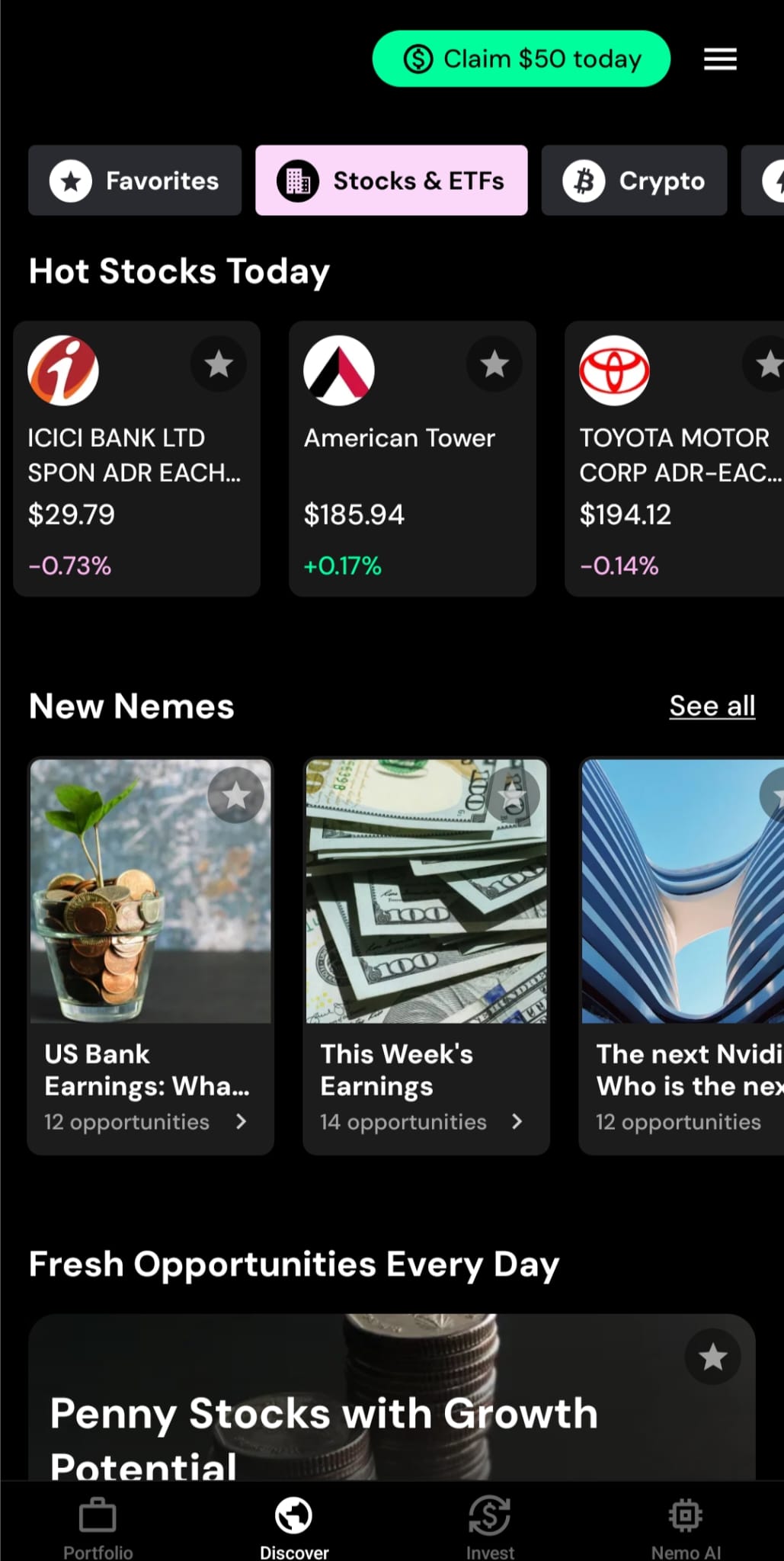
The "This Week's Earnings" Neme
Nemes are Nemo.money themed collections of stocks. The This Week's Earnings Neme groups the companies due to report in the week ahead and is updated every Monday. Open it at the start of the week to see who's reporting, then use the Updates & Videos tab to follow what happens as results come in.
Trending news topics on every stock card
Each stock card in the app has a live Trending news topics panel. It shows the most-covered news themes for that company over the past 48 hours, such as "Earnings Announcement" or "Earnings Estimate Set", and how many articles mention each one. Tap a topic to read the stories behind it. It's a quick way to see whether results are out and what the coverage is focusing on before you open the full report. For the numbers themselves, check the stock's Financials tab.
Notifications and Nemo's social channels
Turn on notifications in the Nemo app so market updates reach you, including when results land overnight Gulf time. For bite-sized explainers and market updates during earnings season, follow Nemo on LinkedIn, Instagram, Facebook, X, Threads, TikTok and YouTube. For more guides like this one, visit the Nemo blog.
Practise this week: earnings due 20–23 October 2026
Several well-known US companies report this week, so it's a good time to try the steps above on a real report. Times are taken from company notices and converted to UAE time (GST, UTC+4). Companies can change their dates, so check each IR page, or the This Week's Earnings Neme in the Nemo app.
Tuesday 20 October
- General Motors: results before the US open, about 2:30pm UAE time. Look for vehicle sales by region and EV sales.
- Netflix: results after the US close, about 12:01am on Wednesday, UAE time. Look for revenue growth and operating margin.
Wednesday 21 October
- Meta: results after the US close; the call starts about 12:30am on Thursday, UAE time. Look for advertising revenue, daily active people and capital spending.
- Tesla: results after the US close; the webcast starts about 1:30am on Thursday, UAE time. Look for vehicle deliveries and automotive gross margin.
- IBM: results after the US close, in the early hours of Thursday, UAE time. Look for software and consulting revenue.
Thursday 22 October
- Procter & Gamble: results before the US open; the webcast starts about 4:30pm UAE time. Look for organic sales growth, and how much came from volume versus price.
Friday 23 October
- American Express: results before the US open, in the afternoon UAE time. Look for card member spending.
The reports also land after a volatile stretch: the Nasdaq had its worst week since June in mid-October, during a pull-back in AI-related stocks. That's a reminder that the wider market mood shapes how results are received.
A five-step checklist for any report:
- Revenue: above or below consensus, and the year-on-year growth rate.
- EPS: GAAP and adjusted, against consensus.
- Margins: up or down compared with last year.
- Guidance: raised, kept or cut.
- The company's own key metric, and what management said about it on the call.
Common mistakes to avoid
- Reading only the headline. "Company X beats" may refer to adjusted EPS alone. Check revenue and guidance too.
- Reacting to the first price move. Prices can swing sharply in after-hours trading, when fewer people are trading, and then reverse once the call starts or the next session opens.
- Ignoring one-offs. Asset sales, legal settlements or tax changes can flatter or hurt a single quarter.
- Treating one quarter as a trend. A single result says less than the pattern over several quarters.
- Forgetting currency and time zone. US results are reported in US dollars, and they usually land overnight in the Gulf.
Frequently asked questions
What is EPS in an earnings report?
Earnings per share is a company's profit divided by its number of shares. It lets you compare profit over time even when the number of shares changes.
What does "guidance" mean?
Guidance is management's own forecast for upcoming revenue, profit or other metrics, usually for the next quarter or the full year. Companies don't have to give it, and some don't.
Why do stocks fall after beating earnings?
Share prices reflect expectations. If guidance is weak, the beat came from one-offs, or investors expected more, the price can fall despite a beat.
When does Tesla report earnings?
Tesla's Q3 2026 results are due after the US market closes on Wednesday 21 October, with a webcast at 5:30pm ET, about 1:30am on Thursday in the UAE.
Where can I read a company's earnings report for free?
On the company's investor relations website, or in its filings on SEC EDGAR.
Can I follow US earnings from the UAE?
Yes. Reports, webcasts and transcripts are public. US results usually arrive in the evening or overnight, Gulf time.
How can I keep track of earnings in the Nemo app?
Open the This Week's Earnings Neme, which is updated every Monday with the companies reporting that week. On any stock card, the Trending news topics panel shows the most-covered news themes for that company over the past 48 hours, including earnings announcements.
The takeaway
You don't need a finance degree to read an earnings report. Start with revenue, EPS, margins and guidance, compare them with what the market expected, then check the one metric that matters most for that business. Practise on a few reports this earnings season and the headlines start to make much more sense.
This earnings season, open the This Week's Earnings Neme in the Nemo app on Monday, check the Trending news topics on the stocks you follow, and practise the five-step checklist when results land.
New to US stocks? Read our guide on how to buy and trade stocks in the UAE.
Terms and conditions apply. This is not investment advice. Past performance is not indicative of future results. Your capital is at risk. See website for Risk Disclosure. Exinity ME Ltd (https://nemo.money) is regulated by ADGM's Financial Services Regulatory Authority.


