


The S&P 500 is the most-watched stock market index on earth. For everyday investors, the easiest way to own a slice of it is through an S&P 500 ETF (Exchange-Traded Fund) like Vanguard's VOO or State Street's SPY.
In June 2026, the investing landscape hit a historic milestone. Vanguard's S&P 500 ETF (VOO) became the first exchange-traded fund in history to cross $1 trillion in assets under management (AUM).
This guide breaks down how the S&P 500 works, why VOO reached this historic scale, and how beginners can start investing in top funds like VOO and SPY with zero commission from just $1 using the Nemo.money app.
What Is the S&P 500 Index?
The S&P 500 (Standard & Poor's 500) is a stock market index that tracks 500 of the largest publicly traded companies in the United States. It covers roughly 80% of the available US market capitalization, making it the ultimate health gauge for the US economy.
- Market Representation: When analysts say "the US market is up," they are almost always referring to the performance of the S&P 500.
- Instant Diversification: Instead of risking your money on a single company, the index spreads your investment across America's biggest businesses.
- Core Holdings: It includes market leaders across all sectors, such as NVIDIA, Apple, Microsoft, Amazon, Alphabet, and Broadcom.
- Current Market Context: By mid-June 2026, when VOO crossed its milestone, the S&P 500 index was trading near record highs around the 7,500 level, driven by strong corporate earnings and artificial intelligence tailwinds.
What Is VOO? (Vanguard S&P 500 ETF)
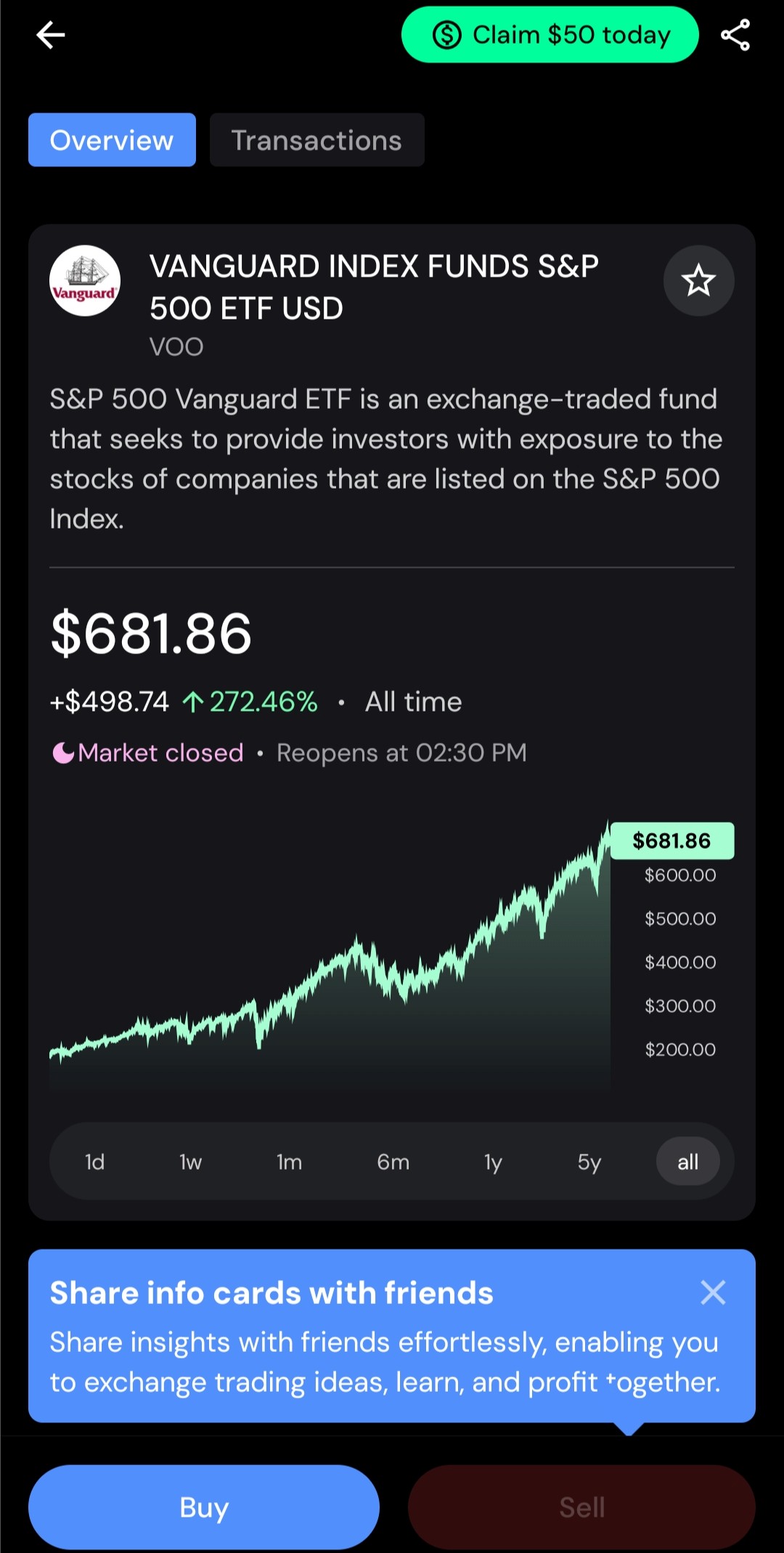
You cannot buy a stock market index directly because it is simply a list of companies. To invest in it, you must buy a fund that tracks it.
VOO is the ticker symbol for the Vanguard S&P 500 ETF. Launched by Vanguard in 2010, VOO is a passive investment fund that holds the exact same 500 companies as the S&P 500 index, in the exact same proportions. When the index goes up or down, VOO mirrors that movement almost perfectly.
VOO Key Specifications & Data (June 2026)
- Fund Provider: Vanguard
- Index Tracked: S&P 500 Index
- Expense Ratio: 0.03% (Ultra-low)
- Assets Under Management: $1 Trillion+ (World's largest ETF)
- Inflows Trend: Attracted over $69 billion in net new investor capital in the first half of 2026 alone.
- Top 5 Holdings: Microsoft, Apple, NVIDIA, Amazon, Alphabet.
VOO vs SPY vs IVV: What is the Difference?
When looking for S&P 500 ETFs, investors frequently ask about the "Big Three": VOO (Vanguard), SPY (SPDR S&P 500 ETF Trust), and IVV (iShares Core S&P 500 ETF). All three track the exact same index, but they differ in cost, structure, and target audience:
- VOO (Vanguard): Features an ultra-low 0.03% expense ratio. It is the most cost-efficient option for long-term, buy-and-hold retail investors.
- IVV (iShares): Also features a competitive 0.03% expense ratio and offers high liquidity, backed by BlackRock.
- SPY (State Street): The oldest ETF in the world, carrying a 0.09% expense ratio. While slightly more expensive for long-term savers, its massive trading volume makes it the preferred tool for institutional investors and short-term day traders.
Simplified Cost Comparison Example: VOO vs SPY
If you invest $1,000, VOO costs you just $0.30 (30 cents) a year in management fees, while SPY costs $0.90 (90 cents) a year. If your portfolio grows to $10,000, you will pay $3 a year for VOO versus $9 a year for SPY. While these amounts seem small, choosing the lower-fee option leaves more of your money in your account to compound and grow over time.
Is VOO a Good Investment for Beginners?
Yes, VOO is widely considered an excellent building block for beginners because it eliminates the need to pick individual stocks. However, index investing is not risk-free. Beginners must understand three critical factors:
- Market Volatility: VOO is 100% equity-based. If the US stock market drops, VOO drops with it. And when one giant inside the index crashes and recovers, your fund quietly carries both journeys — UnitedHealth’s collapse and 38% comeback this year showed exactly how.
- Top-Heavy Concentration: The S&P 500 is market-cap weighted. This means larger companies make up a larger percentage of the fund. Tech giants like NVIDIA, Microsoft, and Apple exert a massive influence on your returns — Apple alone is closing in on a $5 trillion valuation.
- Geographic Risk: VOO only invests in US-registered corporations. It offers zero direct exposure to European, Asian, or emerging markets. If you want the whole world in one fund, our VOO vs VT guide covers how to choose.
How to Invest in the S&P 500 with Nemo.money
Taking control of your financial future doesn’t require a large amount of capital or complex trading tools. The Nemo.money app streamlines index investing for everyone:
- Invest in VOO and SPY from Just $1: Whether you prefer the ultra-low fees of VOO or the heavy liquidity of SPY, you can take advantage of fractional shares to buy a piece of either ETF with whatever budget you have.
- Zero-Commission Trading: Buy and sell eligible US market ETFs like VOO and SPY without losing your capital to transactional fees.
- AI-Powered Insights: Use the built-in AI assistant to learn more about ETFs.
- Real-Time Sentiment: Track live S&P 500 market news and investor sentiment through curated collections called Nemes.
- Earn on Idle Cash: While waiting for market opportunities, earn an exceptional 6% AER interest, paid daily in USD on uninvested cash held in your wallet.
Frequently Asked Questions (FAQs)
What is the expense ratio on VOO vs SPY?
VOO has an annual expense ratio of 0.03%, meaning you pay $3 per year for every $10,000 invested. SPY has an expense ratio of 0.09%, which equates to $9 per year per $10,000 invested. Both fees are automatically deducted from the funds' performances.
Can VOO or SPY make you a millionaire?
Yes. Historically, the S&P 500 has delivered an average annual return of roughly 10% over long periods. Consistent investing through dollar-cost averaging (DCA), combined with the compounding power of reinvested dividends, has historically turned long-term investors into millionaires. However, past performance is no guarantee of future results.
Do VOO and SPY pay dividends?
Yes, both VOO and SPY pay dividends. Because many of the 500 companies in the index (like Apple and Microsoft) pay out dividends, these funds bundle those payments and distribute them to investors quarterly, usually in March, June, September, and December.
Can I buy fractional shares of VOO and SPY?
Yes. Through platforms like Nemo.money, you do not need to buy a full share, which can cost hundreds of dollars. You can purchase fractional shares of both VOO and SPY starting from just $1.
Final Thoughts: Never Miss Out on Compound Growth
The S&P 500 remains the ultimate benchmark for global wealth creation. VOO’s historic climb to a $1 trillion market value proves that low-cost, passive index investing is the preferred strategy for millions of investors worldwide.
Whether you prefer the cost efficiency of VOO or the institutional power of SPY, you can track S&P 500 ETFs and trade eligible funds from $1 with zero commission on the Nemo.money app.
Nemo = Never Miss Out.
Stay informed. Stay ahead.
#SP500 #VOO #SPY #ETF #IndexInvesting #Vanguard #PassiveInvesting #NemoMoney
This is not investment advice. Past performance is not indicative of future results. Your capital is at risk. See website for Risk Disclosure. Exinity ME Ltd (https://nemo.money) is regulated by ADGM’s Financial Services Regulatory Authority.


