


Summary (key takeaways):
- Some of the world's most valuable companies are led by Indian-origin CEOs, including Satya Nadella (Microsoft), Sundar Pichai (Alphabet/Google), Sanjay Mehrotra (Micron) and Arvind Krishna (IBM).
- Under this generation of leaders, several of these companies have grown into multi-trillion-dollar giants, Alphabet has surpassed a $4.2 trillion valuation.
- Separately, India's own economy and stock market have become a major global growth story, one of the reasons "India" is increasingly a theme investors follow.
- A CEO's heritage is a genuine point of pride, but it is not an investment thesis: a company isn't a good investment simply because of who leads it.
- With Nemo.money app, you can explore global markets in USD and invest from $1 with zero commission.
For the millions of Indians living abroad, few stories capture the nation's global rise quite like this one: walk through the leadership of Silicon Valley and corporate America, and you'll find an extraordinary number of Indian-origin names at the very top. It's a source of enormous pride, and also a fascinating window into how talent, education and ambition have reshaped the global business landscape.
The leaders at the top
The list is remarkable. Satya Nadella, born in Hyderabad, has led Microsoft since 2014 and is widely credited with transforming it into a cloud and AI powerhouse, helping make it one of the most valuable companies on earth. Sundar Pichai, from Chennai, has run Google since 2015 and parent company Alphabet since 2019, overseeing an empire, Search, Android, Chrome, YouTube and its Gemini AI, that has grown past a $4.2 trillion valuation.
They're far from alone. Sanjay Mehrotra, a SanDisk co-founder, has led memory-chip maker Micron since 2017, placing him at the heart of the AI hardware boom. Arvind Krishna, an IIT Kanpur graduate, has been IBM's CEO since 2020. Shantanu Narayen has led Adobe for well over a decade. Beyond tech, Indian-origin executives now run consumer and industrial giants too. And in one striking measure of success, Jayshree Ullal, who built Arista Networks into a cloud-networking leader, has an estimated net worth reported to be higher than that of either Nadella or Pichai.
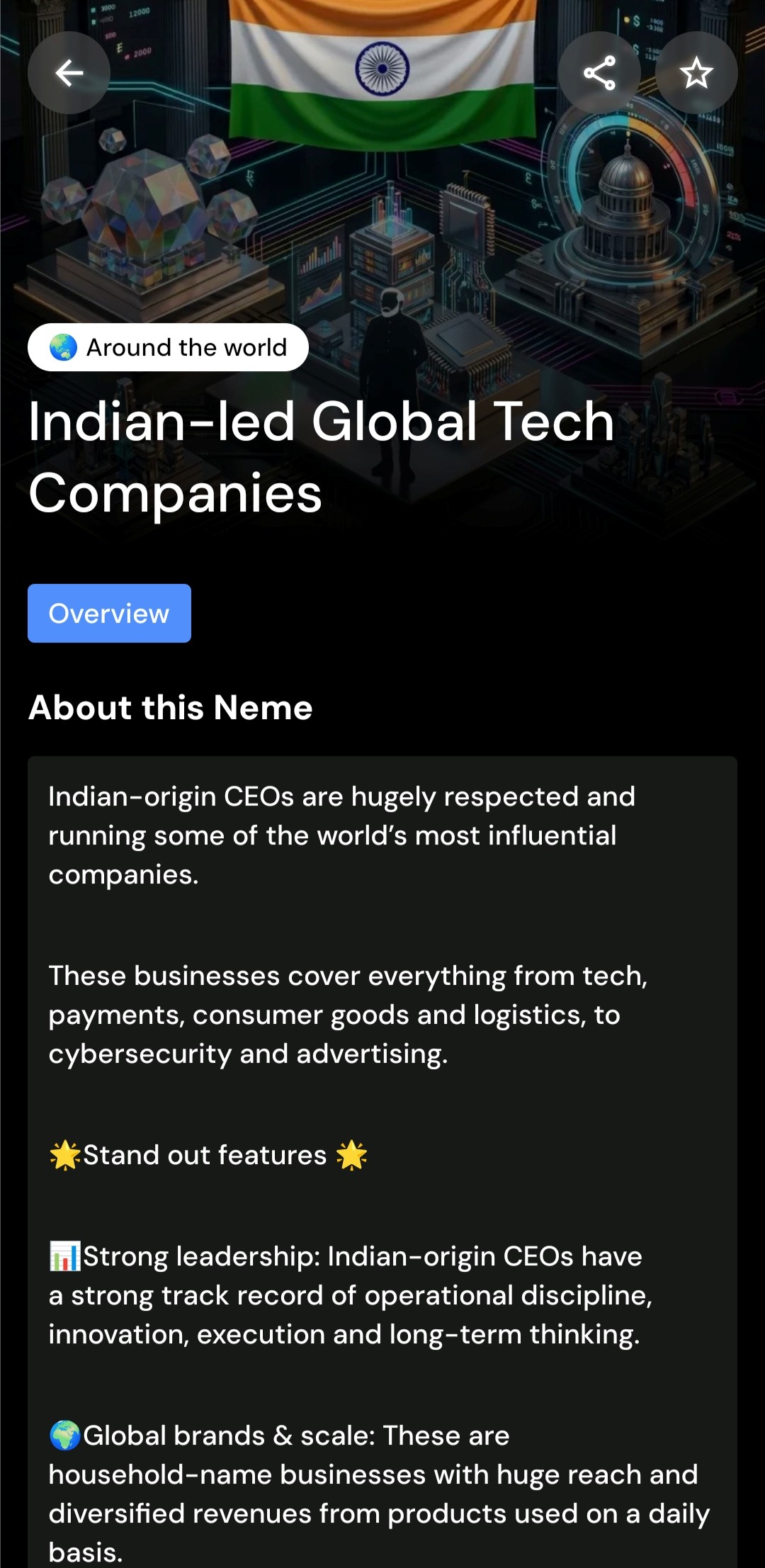
A generation of value creation
What makes this more than a feel-good story is what happened to these companies under their leadership. Nadella's Microsoft went from a business some had written off to a cloud-and-AI leader worth trillions. Pichai's Alphabet cemented its dominance in search and expanded aggressively into AI and cloud. Mehrotra's Micron became a critical supplier in the AI supply chain.
It's worth being precise about the lesson here, though. These leaders presided over enormous value creation, but a company's success is driven by its products, markets, strategy and countless employees, not by the CEO's background. The pride is real and well-earned; the investing takeaway is simply that strong, proven leadership is one of many factors that can matter to a business, not a guarantee of future returns.
Why this generation of leaders is so highly regarded
It's worth asking why these leaders have earned such strong reputations, and the answer says more about individual track records than any national trait. Several common threads are often noted. Many came up through rigorous technical and management education, India's IITs and IIMs among them, before building decades of experience inside the companies they now run; Nadella joined Microsoft in 1992, more than twenty years before becoming CEO, and Pichai spent over a decade at Google before taking the top job. That long apprenticeship tends to produce leaders with deep institutional knowledge and steady hands.
Observers also frequently point to a leadership style, collaborative, customer-focused and calm under pressure, that has suited the modern technology era, alongside a comfort operating across cultures that helps in running vast global organisations. Nadella's turnaround of Microsoft's culture is often cited as a textbook example.
The important caveat, again, is one of framing: this is a story about individuals who built impressive records, not evidence that any background guarantees success. Reputation is earned company by company, decision by decision. The pride the diaspora feels is well-deserved precisely because these achievements were hard-won, not automatic.
The other India story: a rising economy
Alongside the diaspora's boardroom success runs a parallel story closer to home: India itself has become one of the world's most closely watched growth markets. It's among the fastest-growing major economies, with a young population, a booming digital and consumer sector, and a stock market that has drawn increasing global attention.
For investors, "India" has become a genuine theme, spanning the country's own listed companies (in technology, banking, energy and consumer goods) and the global funds and indices that track them. Many international investors gain exposure through India-focused funds rather than individual shares. As with any single-country market, it carries its own risks, currency movements, valuation swings and policy shifts among them, so it's an area to understand rather than assume.
How this connects to investing
There are really two ways this story touches markets. First, the global companies led by Indian-origin CEOs, Microsoft, Alphabet, Micron, IBM, Adobe and others, are listed businesses that investors around the world can research. Second, India's own market offers a distinct growth theme for those interested in emerging economies.
The important caveat ties both together: neither a CEO's heritage nor national pride is a reason to buy a stock. These are companies and markets to understand on their fundamentals, the same discipline that applies to any investment. Pride can spark curiosity; research should drive decisions.
Frequently asked questions
Which major global companies have Indian-origin CEOs?
Prominent examples include Microsoft (Satya Nadella), Alphabet/Google (Sundar Pichai), Micron (Sanjay Mehrotra), IBM (Arvind Krishna) and Adobe (Shantanu Narayen), among others across technology, consumer goods and industry.
Why are so many global CEOs of Indian origin?
Commentators point to a combination of factors: India's strong engineering and management education (such as the IITs and IIMs), widespread English-language fluency, large-scale migration of skilled professionals, and experience navigating complex, diverse environments. There's no single cause, and it's a widely discussed but debated phenomenon rather than a settled explanation.
Have these companies performed well under Indian-origin CEOs?
Many have grown substantially, Microsoft and Alphabet both became multi-trillion-dollar companies during these tenures. However, company performance depends on many factors, and past performance does not predict future results. A CEO's background is not itself an investment signal.
Can I invest in Indian companies or the India growth story?
Yes, typically through India-focused funds and indices, or individual listed companies where accessible. India is considered a high-growth but higher-risk market, with currency and policy risks to weigh.
Is a company a good investment because it has an Indian-origin CEO?
No. Heritage and national pride are not investment criteria. A company should be judged on its fundamentals, strategy, financials, market and valuation, not on who leads it.
How can I invest in global companies from the UAE?
On the Nemo.money app you can explore global markets in US dollars and invest from $1 with zero commission.
The takeaway
The rise of Indian-origin CEOs to the summit of global business is a genuine source of pride for the diaspora, and a remarkable chapter in the story of modern India. Paired with the growth of India's own economy, it's easy to see why "India" resonates so strongly with investors of Indian heritage. Just remember the discipline that applies everywhere: let the pride inspire your curiosity, but let research, not sentiment, guide your decisions.
Never miss out. Stay informed, stay ahead.
Explore global stocks on the Nemo.money app, and invest from $1 with zero commission.
This is not investment advice. Past performance is not indicative of future results. Your capital is at risk. See website for Risk Disclosure. Exinity ME Ltd (https://nemo.money) is regulated by ADGM's Financial Services Regulatory Authority.


