


Talking about the weather used to be small talk. In the UAE, it's now impossible to ignore. In the opening days of August 2026, the country recorded its first 50°C reading of the year (50.0°C at Al Shawamekh, Abu Dhabi), as it entered the Al Mirzam period, traditionally the hottest stretch of the summer, running to around 24 August. The National Centre of Meteorology expects this August to average about 35.7°C, "slightly higher than average", extending a clear multi-year warming trend (August 2025 hit 51.8°C, the UAE's hottest August reading in nine years). Every year, as July and August temperatures push past 50°C inland and into the mid-40s on the coast, schools close and much of the expat population heads abroad until the heat eases in September, a seasonal exodus so predictable that events, conferences and even construction wind down around it.
That lived reality, heat you can't ignore, is a local window onto a genuinely global trend. This isn't just a Gulf story: 2025 was the UK's warmest year on record (a mean of 10.09°C, per the Met Office) and its hottest-ever summer, and 2026 has already smashed UK May and June records, including the hottest June day on record at 36.1°C in Hampshire, though still below Britain's all-time high of 40.3°C set in July 2022. Zoom out and the pattern is stark: the last ten years are the ten hottest ever recorded globally, and the Met Office expects 2026 to be a fourth straight year running more than 1.4°C above pre-industrial levels. From the Gulf to Europe, extreme heat is becoming the baseline, not the exception.
That trend has become one of the biggest, fastest-moving stories in global markets. Record heat drives record electricity demand for cooling. Climate goals are rewiring entire economies. And, in a twist almost nobody predicted five years ago, the artificial-intelligence boom has turned "who generates the power?" into one of the defining investment questions of the decade.
At the centre of it sits green energy, solar, wind, nuclear, batteries and the grid that ties them together. This guide breaks down how the energy transition works as an investing theme, why 2026 has been such a pivotal year, the honest risks, and the UAE's surprisingly central role. If it leaves you wanting to explore listed energy stocks and funds, you can do that from just $1 with zero commission on the Nemo.money app.
Why "Green Energy" Became a Serious Investment Theme
For years, clean energy was framed mainly as an ethical or environmental choice. In 2026, it's also a story about sheer economics and demand:
- Clean energy investment is now enormous. Global energy investment is on track for record levels in 2026, with the International Energy Agency estimating around $2.2 trillion flowing into clean energy this year, roughly double the ~$1.2 trillion going into fossil fuels.
- Costs have collapsed. Utility-scale solar, wind and battery storage have become dramatically cheaper over the past decade, making them competitive with, or cheaper than, conventional power in many places. Solar investment alone is set to exceed $500 billion in 2026, more than any other single energy technology.
- Renewables have overtaken coal. In 2025, for the first time in history, renewables generated a larger share of the world's electricity than coal (around 34% versus coal's declining share), a genuine structural shift, with nuclear taking fossil-free sources to over 40% of global power.
The Plot Twist: AI Is Driving an Electricity Boom
Here's the development that reframed the entire sector. Artificial intelligence runs on data centres, and data centres are astonishingly power-hungry. Their electricity consumption is scaling from gigawatts toward multi-gigawatts, pushing projected power demand to levels the grid simply wasn't built for.
Suddenly, the question isn't just "can we go green?" but "where on earth will we find enough reliable electricity to run AI?" That has turned energy generation into a growth story, and split investor attention across two camps:
- Renewables (solar & wind): cheap and clean, but intermittent, they depend on the sun shining and the wind blowing. Great for the grid overall, but a data centre can't go dark when a cloud passes.
- Baseload clean power (nuclear): available 24/7 regardless of weather. This is why nuclear, and especially next-generation Small Modular Reactors (SMRs), has roared back into fashion as an "AI power" play, alongside battery storage that can smooth out renewables.
The Main Ways to Invest in Green Energy
For someone exploring the theme, the listed opportunities broadly fall into a few buckets (all named as examples to research, not recommendations):
- Diversified clean-energy utilities: large, relatively stable operators like NextEra Energy (NYSE: NEE) and Constellation Energy (NASDAQ: CEG), which combine renewables, nuclear and grid-scale generation. Generally lower-risk than pure-plays, and some pay dividends.
- Pure-play solar: companies focused on solar manufacturing and installation, such as First Solar (NASDAQ: FSLR) and Enphase Energy (NASDAQ: ENPH). Higher growth potential, but more volatile and policy-sensitive.
- Nuclear & SMRs: from established players to speculative newcomers like NuScale Power (NYSE: SMR) and uranium miners like Cameco (NYSE: CCJ). Potentially high upside on the "AI baseload" thesis, but often highly speculative and volatile.
- Storage & grid: battery and fuel-cell names like Bloom Energy (NYSE: BE) and Fluence (NASDAQ: FLNC), plus the "picks and shovels" of the grid build-out.
- ETFs (the simplest starting point): rather than picking one company, funds like the iShares Global Clean Energy ETF (ICLN) or solar-focused TAN give diversified exposure to the whole theme in a single trade, usually the most sensible route for beginners.
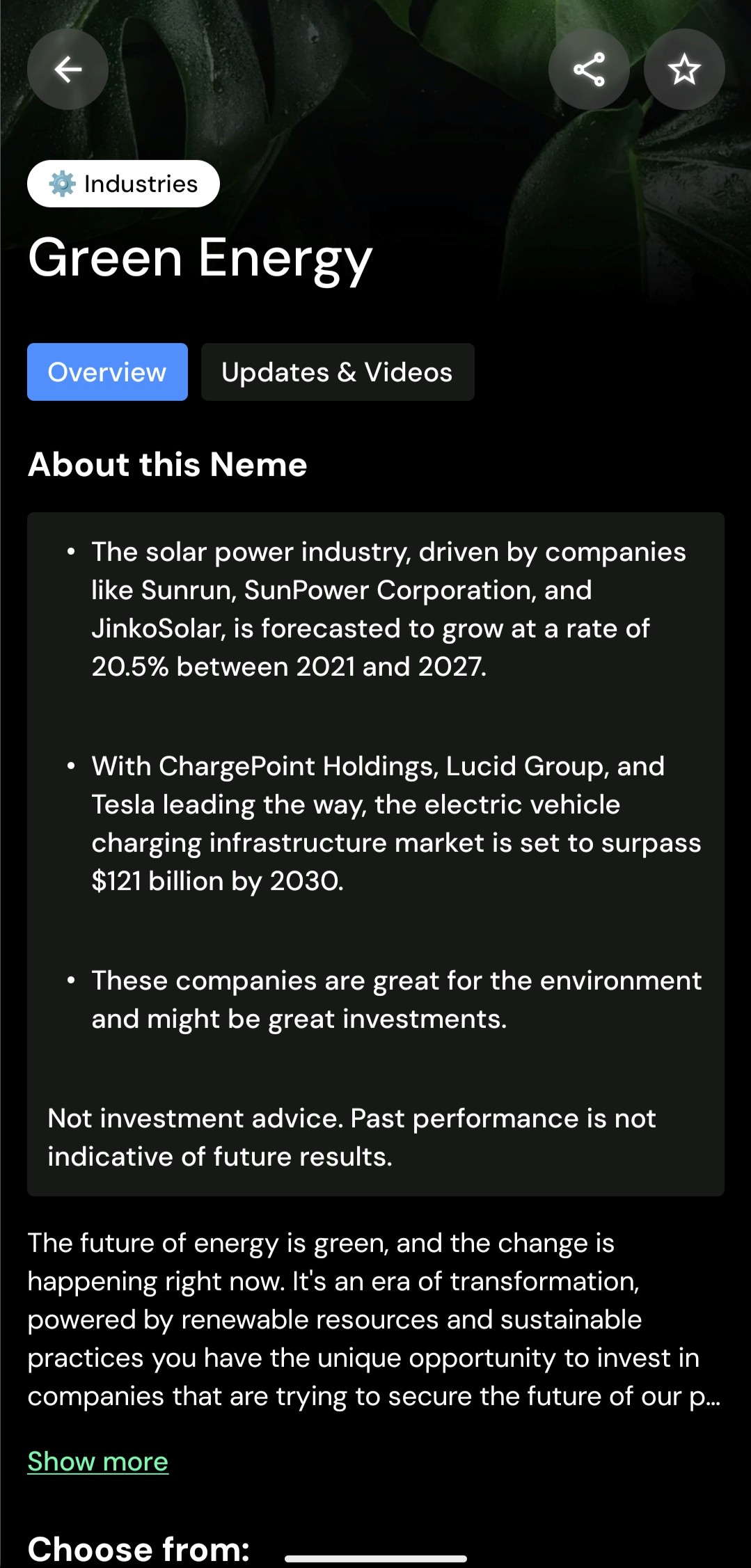
- Nemo Green Energy Neme: The Nemo.money app offers a ready-made "Green Energy" Neme, a curated collection that brings the whole theme into one place. It spans the segments covered above: solar (First Solar, SunPower, JinkoSolar, Canadian Solar, SolarEdge, Enphase, Sunrun, Array Technologies), diversified clean-energy utilities (NextEra Energy, Ormat Technologies, Atlantica), wind and clean-energy ETFs (Invesco Solar/TAN, First Trust Global Wind/FAN, First Trust NASDAQ Clean Edge/QCLN), EV and charging (Tesla, Lucid, ChargePoint), and fuel-cell/biofuel names (Ballard Power, Clean Energy Fuels, Gevo) and clean-energy ETFs (Invesco Solar/TAN, First Trust NASDAQ Clean Edge Green Energy/QCLN, First Trust Global Wind Energy/FAN). It's a simple way to explore the green energy opportunity and the companies and funds driving it.
The UAE: An Oil Giant Betting Big on Clean Energy
Here's a genuinely fascinating angle for this region. One of the world's great oil producers is also becoming a clean-energy powerhouse, a deliberate hedge for a post-oil future:
- Masdar (Abu Dhabi Future Energy Company) has reached around 65 GW of global clean-energy capacity and is targeting 100 GW by 2030.
- Al Dhafra Solar near Abu Dhabi is among the world's largest single-site solar plants (~2 GW), and the Mohammed bin Rashid Al Maktoum Solar Park in Dubai is scaling toward 8 GW.
- The Barakah Nuclear Energy Plant, the Arab world's first, already supplies roughly 25% of the UAE's electricity as clean baseload power, exactly the "always-on" generation the AI era prizes.
- The UAE has even launched what it calls the world's first 24/7 solar-plus-storage facility, pairing a giant solar array with battery storage to deliver round-the-clock clean power, directly tackling the intermittency problem.
For investors, the UAE story illustrates the whole theme in miniature: even the biggest fossil-fuel players are pouring capital into the transition. The UAE's climate role now reaches beyond energy, too. In August 2026 it led "Operation Green Shield," a UN-backed multinational crackdown on environmental crime across the Amazon Basin (reportedly 839 arrests and over $280 million in assets seized in 17 days), through its I2LEC initiative launched at COP28. It's not an investment story in itself, but it's a signal of how seriously the region is positioning itself around climate and sustainability, the backdrop against which its clean-energy bets are being made.
The Honest Risks (Please Read This Part)
Green energy is a powerful long-term theme, but it has been a genuinely bumpy, and at times painful, investment. Being clear-eyed matters:
- It is NOT a one-way bet. Clean-energy stocks have had rough stretches, many fell sharply when interest rates rose (higher rates make capital-intensive energy projects more expensive) and on shifting policy. A great theme does not guarantee a great stock.
- Policy and politics dominate. Subsidies, tax credits and tariffs can make or break these companies almost overnight. Recent tariffs on imported solar components, for example, squeezed margins across the industry.
- Some corners are highly speculative. A number of hyped names, particularly newer SMR and hydrogen companies, have soared on the AI-power narrative despite limited revenue or profit. Big stories can attract big risk.
- Intermittency and execution are real. Renewables still need storage and grid upgrades to be truly reliable, and large energy projects face permitting, supply-chain and cost overruns.
- A theme is not a stock. "Green energy will grow" can be true while any individual company disappoints. Diversification (for example, via an ETF) is one way investors manage that, though it never removes risk.
How to Explore Energy Stocks with Nemo.money
If the energy transition interests you, the Nemo.money app lets you explore the listed players and funds:
- Invest from Just $1: Fractional shares let you start small with eligible stocks and ETFs.
- Zero-Commission Trading: Buy and sell eligible US-market stocks and ETFs without commission fees.
- AI-Powered Insights & Nemes: Explore curated, themed stock collections (Nemes), with real-time data and sentiment.
- Earn on Idle Cash: Earn 6% AER interest, paid daily in USD, on uninvested cash in your wallet.
Frequently Asked Questions (FAQs)
How do I invest in green energy?
You can invest in the energy transition through several routes: diversified clean-energy utilities (like NextEra Energy), pure-play solar companies (like First Solar or Enphase), nuclear and Small Modular Reactor names, battery and grid companies, or, most simply for beginners, a clean-energy ETF (like ICLN or TAN) that bundles many companies into one trade. Each carries different risk; all are examples to research, not recommendations, and your capital is at risk.
Why is AI driving demand for clean energy?
Artificial intelligence runs in data centres that consume enormous, growing amounts of electricity, more than existing grids were designed for. This has created a scramble for new power generation. Renewables (solar and wind) are cheap but intermittent, while nuclear provides reliable 24/7 "baseload" power, which is why both renewables and nuclear have become central to the "AI power" investment story.
Are green energy stocks a good investment?
There's no simple answer. The long-term theme is strong (record investment, falling costs, rising demand), but clean-energy stocks have been volatile and had difficult periods, hurt by rising interest rates, policy changes and tariffs. Some newer names are highly speculative. A strong theme doesn't guarantee any single stock will do well.
What is the UAE doing in clean energy?
Despite being a major oil producer, the UAE is investing heavily in clean energy as a long-term hedge. Through Masdar it's targeting 100 GW of global clean-energy capacity by 2030; it operates some of the world's largest solar plants (Al Dhafra, the MBR Solar Park); its Barakah nuclear plant supplies around 25% of the country's electricity; and it has launched a pioneering 24/7 solar-plus-storage project to deliver round-the-clock clean power.
What's the difference between solar and nuclear as investments?
Solar (and wind) is cheap, fast to build and widely available, but intermittent, output depends on weather, so it needs battery storage to be reliable. Nuclear is expensive and slow to build but provides constant, weather-independent "baseload" power, which is increasingly prized for AI data centres. As investments, solar tends to be more policy- and tariff-sensitive, while nuclear (especially SMRs) ranges from stable large operators to highly speculative newcomers.
Final Thoughts: A Long-Term Theme, Not a Shortcut
The weather, and the world's response to it, has become one of the most important forces in investing. The energy transition is backed by record capital, collapsing costs and, now, an unexpected surge in demand from AI. That makes green energy a genuinely significant long-term theme, and the UAE's transformation from oil giant to clean-energy hub shows just how serious the shift is.
But "important theme" and "easy money" are very different things. Clean energy has been volatile, policy-driven and, in places, speculative. Treat it as a long-term area to understand rather than a quick win, weigh the risks, and if it interests you, you can explore listed energy stocks and ETFs from $1 with zero commission on the Nemo.money app.
Nemo = Never Miss Out.
Stay informed. Stay ahead.
#GreenEnergy #CleanEnergy #Investing #Solar #Nuclear #EnergyTransition #NemoMoney
This is not investment advice. Past performance is not indicative of future results. Your capital is at risk. See website for Risk Disclosure. Exinity ME Ltd (https://nemo.money) is regulated by ADGM's Financial Services Regulatory Authority.


